

Demetrious Johnson has clarified his UFC criticism while questioning Sean Strickland’s pay. In his October 14 video, he distinguished the promotion from MMA itself and argued that winning should outweigh entertainment value.
Demetrious Johnson Explains His UFC Criticism
The sport is mixed martial arts
Johnson praised Movsar Evloev’s ability and explained that his earlier remarks targeted inconsistent roster standards. He cited Muhammad Mokaev and Michael Page as examples. His closing argument also challenged how title opportunities are allocated, contrasting competitive achievement with commercial appeal.
On Strickland, Johnson wanted documented earnings rather than competing assertions. He questioned the fighter’s share of the rights agreement but acknowledged that the actual pay total remains unknown. He also recalled having records of his own UFC compensation.
Johnson recognized the significance of a recently signed contract. A producer’s suggestion that Strickland had been pressured into signing was explicitly speculative, not established evidence. He argued that organizations seek bargaining leverage and wanted greater clarity about the disagreement.
Why The Earlier Evloev Remarks Drew Attention
The new response follows Johnson’s earlier discussion with Ariel Helwani. In that conversation, he denied having a personal issue with Evloev and focused on the gap between promises about elite competition and decisions about marketability. That distinction matters after his previous remarks about Evloev’s finishes.
Johnson also extended the criticism beyond one promotion, recalling questions he had asked about athletes disappearing from ONE’s competitive picture. His concern was how fans could remain invested without understanding those decisions. He accepted that promoters would make business choices, but wanted the rationale expressed honestly. He also urged viewers to decide whether they wanted to support the product as presented, rather than expecting every decision to follow a sporting hierarchy. That original discussion included Page’s outside options and Johnson’s interest in understanding the competing offers. The earlier interview provides context rather than a second new announcement.
What Dana White Said About Strickland’s Contract
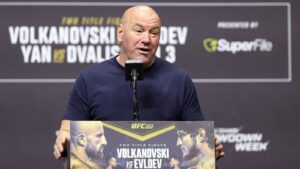
At his October 13 press conference, White said he had not personally discussed the complaints with Strickland and had instead heard about them through social media. His central answer was that Strickland signed a new contract in May. He returned to that point when asked about the fighter’s interest in boxing.
White also disputed the earnings figure being circulated without supplying a replacement amount or presenting the contract. When asked how he separates a serious complaint from Strickland’s usual commentary, he again emphasized the agreement’s recency. White’s contract response therefore explains the UFC’s public position, but does not independently settle the compensation question. Neither the press conference nor Johnson’s response establishes a verified purse, a promised boxing release, or a renegotiated agreement. His answer did not disclose the agreement’s duration, payment schedule, or any conditions governing a move into another sport. The two men are addressing related but different parts of the dispute: White pointed to a recent signature, while the fairness and transparency of compensation remained the broader questions.
The Rights Deal Is Not An Individual Fighter’s Purse
The Paramount agreement announced in August 2025 covers seven years beginning in 2026, with an average annual value of $1.1 billion. That produces the $7.7 billion term value referenced in the debate. It is not a one-year payment, and the announced schedule weights payments toward the later years.
The U.S. distribution package includes 13 numbered events and 30 Fight Nights on Paramount+, with selected numbered events also appearing on CBS. The announcement replaced the previous U.S. pay-per-view model with access at no additional charge for Paramount+ subscribers. Those terms describe a distribution relationship, not Strickland’s individual compensation arrangement.
That distinction prevents a misleading comparison between a multiyear commercial headline and one athlete’s earnings. The public announcement gives the scale and structure of the rights package; it does not identify a guaranteed percentage for Strickland or resolve the figures disputed in White’s answer. It also cannot establish a specific fight purse simply by dividing the total value by the number of events.
A Former Champion’s Perspective On Opportunity
Johnson’s perspective comes from championship careers in both organizations. He defended the UFC flyweight title 11 times before winning ONE’s flyweight Grand Prix and later its MMA title. He ended his trilogy with Adriano Moraes with a decision win in May 2023, then announced his retirement at ONE 168 in September 2024.
This is a new commentary video, not a fresh retirement announcement. The focus remains the relationship between sporting achievement and promotional discretion, a debate also reflected in Page’s explanation of his Misfits agreement.
His clarification follows.