
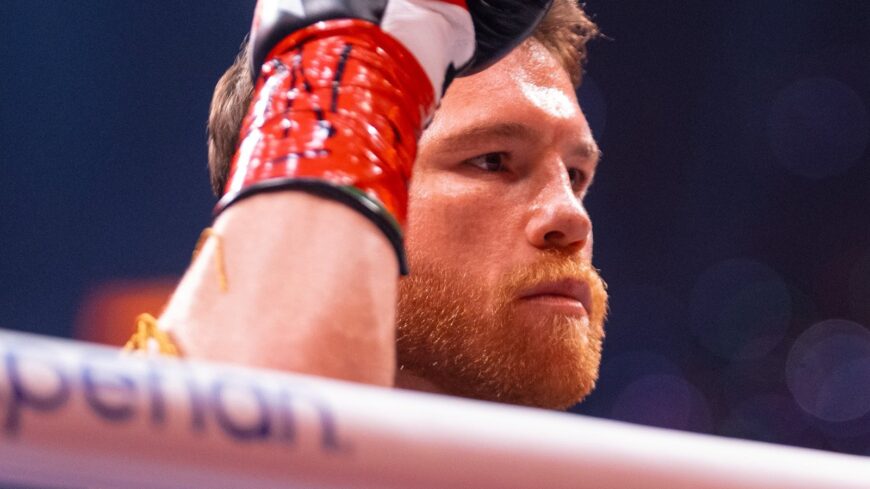
Canelo Alvarez dismissed Christian Mbilli’s age-based criticism in a new interview, calling the unbeaten challenger “too simple” while outlining his recovery from elbow surgery and the lessons he took from losing to Terence Crawford.
The Mexican star spoke Tuesday during a complete six-minute interview released ahead of his next fight. Alvarez said the long break allowed him to address an injury properly, restored the enthusiasm he remembers from the beginning of his career and left him eager to return as a challenger rather than a champion at super middleweight.
Canelo Says The Layoff Helped His Elbow Recovery
Alvarez has been away from competition for nearly a year and underwent elbow surgery during that period. Instead of forcing an accelerated comeback, he said he allowed the joint and the rest of his body to recover before resuming full training and sparring.
“I feel great. I took my time to do everything, to take care of my body, because sometimes you let the injury get even bigger. So now I took my time to take care of my body, and I feel great. I started training, and I do so much sparring, and I feel great.”
The break did not change his view of what remains to be established. Alvarez separated public approval from his personal standards, saying his record already answers questions about his place in boxing. Continued achievement and the chance to set new marks are what still draw him to camp.
“I don’t think I have anything to prove to anybody. I just love this part of boxing. Now I know I have more to accomplish. I know every time I step in the arena, I break some record, so that keeps me motivated.”
Asked what the Crawford defeat taught him, Alvarez did not identify a single tactical error. His answer was broader: the loss showed him choices he should avoid, while reinforcing the value of entering the gym prepared to add something new to his game.
“I learned things I don’t need to do. You learn from everything, so I learned my lesson, and I just always keep learning. I always try to go to the gym to learn something new. So I love this part.”
He also rejected the suggestion that the next performance must satisfy outside doubts about whether the best version of him remains available. The standard, he said, is internal.
“I need to prove myself. I need to prove myself, and I don’t need to show anybody anything. They say I’m old and this and that, but they’re going to see.”
“My motivation is the love for the sport. Like I say, I always break records when I fight, so I have that feeling inside me like before, like when I was 15 years old.”
Mbilli’s Pressure Is The Style Alvarez Wanted
For the first time in six years, Alvarez expects to enter a 168-pound contest without championship status. He described that reversal as unfamiliar but energizing, comparing the challenger’s position to the beginning of his rise.
“I feel good. Like I say, it feels different, but it feels like the first time.”
Mbilli’s championship standing was the starting point for selecting him, according to Alvarez. The veteran also identified the challenger’s physical strength, activity and appetite for the opportunity as qualities that make the matchup credible. Those attributes do not require Alvarez to chase a reluctant opponent, which he believes should create a more revealing contest.
“Because he’s a champion. He’s a champion, and I think he’s a dangerous fighter. He throws a lot of punches. He’s strong. He’s hungry, and that’s why.”
“I love that style. It’s going to be a good fight because the styles make the fight perfect. He’s going to come and throw a lot of punches, and I’m a counterpuncher. So that’s going to be a hard fight. But I enjoy that kind of fight because, at the end of the day, it’s a lot of action, and you can show a lot of things, and you don’t need to chase anything.”
The sharpest answer came when Alvarez was asked about Mbilli’s contention that age and accumulated mileage have made him vulnerable. Alvarez said the number would not alter the outcome and predicted that the challenger will discover the difference in class when they share the ring.
“No matter what age I have, in this life he’s not going to beat me. If I have 40 years, 50 years, in this life he’s not going to beat me. And he’s going to see how good I am.”
“He’s too simple. I think he’s going to be very simple for me.”
Alvarez said he watched Mbilli’s fight with Lester Martinez and saw two boxers willing to exchange. He did not dismiss the action, but distinguished his own counterpunching and experience from what Mbilli encountered there.
“They made a good fight because they both throw punches, and that’s it. But, you know, I’m different.”
The Goal Is Better Fights, Not A Fixed Exit Date
Alvarez attributed the restrained performances against Crawford and William Scull partly to stylistic friction. In his view, some opponents make it difficult for either boxer to display a complete arsenal, whereas Mbilli’s forward pressure should leave more openings for both men.
“The styles make the fight, always. I think with those kinds of styles it’s very difficult to show yourself at your best.”
He offered no specific number when asked how many contests remain in his career. Having already collected the accomplishments that once defined his ambition, Alvarez described the next phase in simpler terms: stay active when the matchup matters, continue setting commercial and competitive records, and choose bouts capable of producing strong action.
“I don’t know. Just keep fighting and keep breaking records and make the best fights possible out there. And that’s it, because I accomplished everything in boxing.”
“Every time I step in the ring, I break records, so I’m excited for that.”
The enforced rest appears to have sharpened that interest. Alvarez said he rarely spends this long away from the sport and promised supporters a fully committed camp rather than a cautious return.
“My best. I got the feeling inside me like I want to train really hard and come back. Very few times I rest this much, and I’m always active in boxing. I feel very excited to come back.”
“We don’t know. We’re going to see. But it’s going to be a hard time for him.”
A July report documented Alvarez confirming the Mbilli fight and responding to criticism over boxing’s sanctioning fees. The earlier matchup announcement established the championship setting; Tuesday’s interview adds a distinct source and development by supplying Alvarez’s full assessment of Mbilli, his medical recovery and his response to the Crawford loss.
Alvarez did not guarantee a stoppage. He acknowledged Mbilli could reach the final bell, but his broader prediction was decisive: the challenger’s pressure will give him the kind of fight he wants, while age will not provide the advantage Mbilli expects.